Winch Out Service on the Washington Coast
What to do when your vehicle is stuck in beach sand, coastal mud, or a roadside ditch and the Pacific tide is moving in.
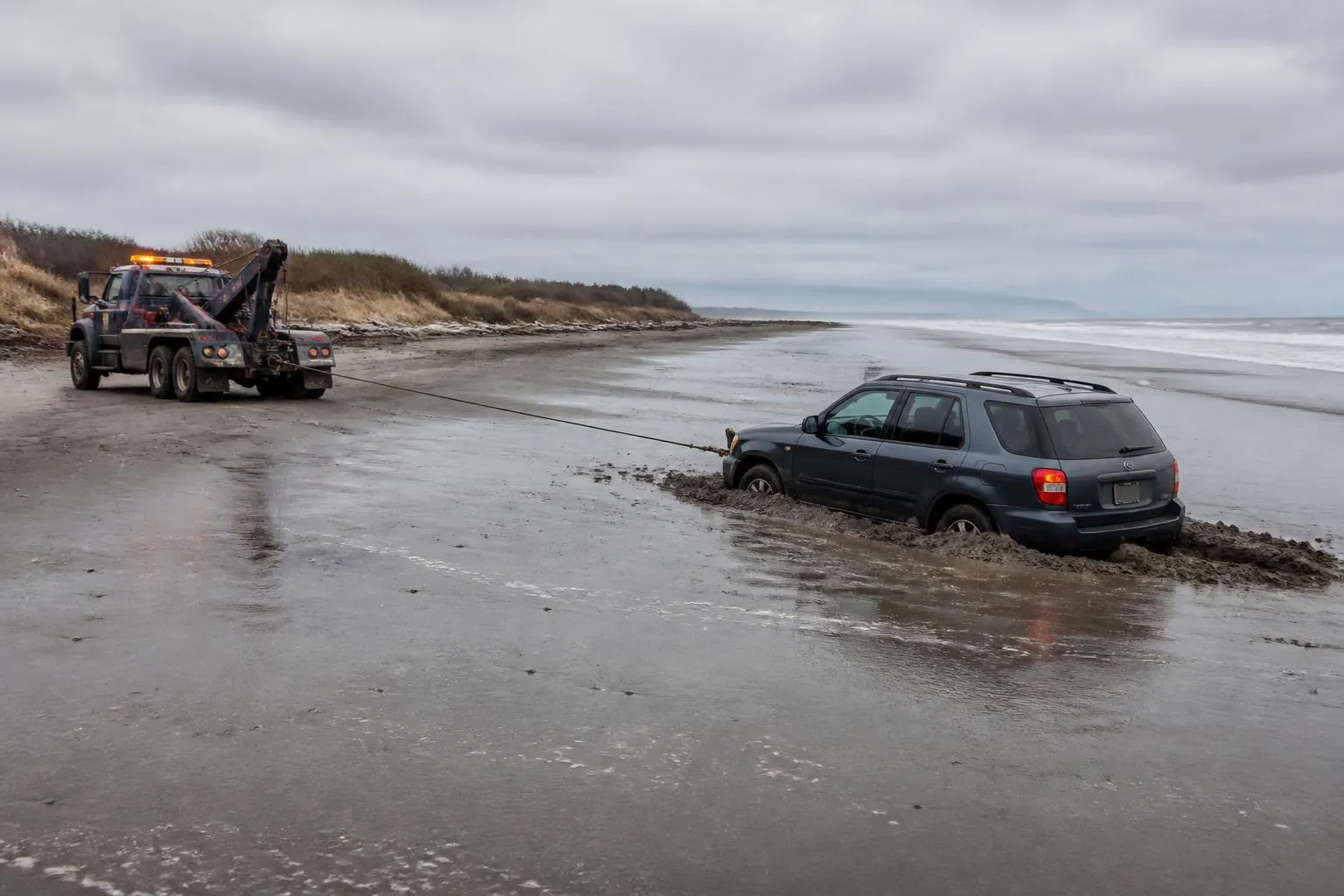
If you are reading this from the driver's seat of a vehicle that will not move, take a breath. You are not the first person to get stuck on the sand at Ocean Shores, and you will not be the last. What matters right now is the order in which you act, because on this stretch of the Washington coast, the thing working against you is not only the sand. It is the clock.
The Pacific tide on Grays Harbor County beaches does not always creep in gradually. It can fill the flat, wide beach face quickly, and a vehicle sitting on apparently dry sand at the beginning of a phone call can be surrounded by moving saltwater before the call ends.
This guide explains what to do during the first ten minutes, how a professional winch out service differs from a standard tow, and how prompt action can keep a difficult afternoon from becoming a total vehicle loss.
Beck's Towing Road & Beach Recovery provides emergency towing and specialized beach recovery from Ocean Shores to Copalis Beach, Pacific Beach, Hoquiam, Aberdeen, and communities throughout Grays Harbor County.
The First Ten Minutes: Your Emergency Checklist
Complete the following actions in order. Each step protects people, preserves your available recovery window, or makes it easier for the responding operator to reach you with the correct equipment.
Move Everyone to Higher Ground
Get every person and pet out of the vehicle and onto firm, higher ground. People come first. A vehicle can be replaced.
Stop Spinning the Tires
Every rotation digs the tires deeper and packs wet sand around the axles and undercarriage. Ten seconds of spinning can turn a straightforward pull into a full excavation.
Check the Tide Direction
Look at a current Grays Harbor or Point Brown tide table and determine whether the tide is flooding or ebbing, plus the remaining time until high water.
Identify Your Exact Location
Note the nearest beach approach, street end, landmark, distance from the dunes, and any other detail that can help dispatch locate you quickly.
Call for Emergency Towing
Do not wait to see whether the situation improves. Tell dispatch that the vehicle is stuck, whether the tide is flooding, and what type of vehicle needs recovery.
Remove Critical Belongings
When it is safe to do so, take wallets, medications, keys, laptops, identification, paperwork, and other irreplaceable items out of the cabin.
An ebbing tide with several hours of falling water may leave time for a measured recovery. A flooding tide makes the same situation time-critical. Tell dispatch which condition you are facing first.
How Pacific Tides Work on This Coast
Ocean Shores and the surrounding beaches sit on a long, gently sloped sand plain. That gradual slope helps make portions of the beach drivable, but it also makes the incoming tide deceptive. On a steep beach, the waterline may climb only a limited distance across the shore. On a broad, flat beach, the same vertical rise can push the waterline dozens of yards inland.
Two Unequal High Tides
The Washington coast generally experiences two high tides and two low tides most days. The two highs are often different heights, and the higher tide may reach much farther inland.
The Flood Cycle Accelerates
Water rise is not experienced as a perfectly even shoreline advance. The middle portion of a flooding tide can close open ground much faster than drivers expect.
Wind and Swell Add Water
A published tide prediction is a baseline. Strong onshore wind, storm conditions, and heavy winter swell can push the actual waterline beyond the predicted mark.
Saturated Sand Can Liquefy
Sand covered by a previous tide may look flat and firm. Once a vehicle's weight rests on it, water and sand can shift beneath the tires and allow the vehicle to settle.
The same low tide that opens the clam-digging flats eventually returns to reclaim that ground.
This is one reason many local recoveries happen during razor clam openings. Drivers follow the receding water far onto the flats, park near productive digging areas, and then have less time than expected to leave before the tide returns.
Why a Stuck Vehicle Can Become a Total Loss
Saltwater exposure is different from ordinary freshwater exposure. Once saltwater reaches a vehicle, corrosion and contamination begin immediately and may continue after the exterior appears dry.
- First Contact Wheel bearings, brake components, exhaust parts, hubs, and exposed suspension hardware are among the first systems reached.
- Drivetrain Saltwater can enter differential or transmission housings through vents and breather openings, contaminating lubricants.
- Frame and Body Salt can remain inside body seams and boxed frame sections that are difficult to rinse or inspect.
- Electronics Wiring harnesses, sensors, connectors, and control modules may develop faults days or weeks after the original exposure.
- Interior Carpet, padding, insulation, and seat foam hold moisture and salt and may contribute to an insurer declaring the vehicle a loss.
- Engine Water entering the air intake can hydrolock the engine, especially when a driver continues trying to power out through rising water.
If saltwater has reached the vehicle, do not keep trying to start or drive it. Arrange professional recovery and flatbed transport for inspection.
The value of fast recovery is not measured only against the cost of the service call. It is measured against the difference between a vehicle removed before the water arrives and one that remains through one or more tide cycles.
What a Winch Out Service Actually Is
People often use the words towing and winching interchangeably, but they describe different stages of roadside and off-road assistance.
Standard Tow
A tow transports a vehicle that is already accessible on firm ground from one location to another.
Professional Winch Out
A winch out extracts a vehicle from soft sand, coastal mud, a saturated tide flat, a roadside shoulder, or a ditch so it can safely return to firm ground or be loaded for transport.
A vehicle buried to the rocker panels in wet sand may require several times its own weight in pulling force to break free. That force must be applied gradually through rated equipment, at an appropriate angle, and from a stable recovery vehicle or anchor point.
Incorrect rigging, unsuitable attachment points, or sudden shock loading can damage the vehicle and create dangerous flying debris if a component fails under tension.
What Makes Professional Beach Recovery Possible
A properly equipped recovery unit carries tools designed for soft surfaces and high pulling loads. Standard pavement-focused towing equipment may not be sufficient for a vehicle buried on a tide flat.
| Recovery Equipment | Why It Matters |
|---|---|
| 4x4 Recovery Vehicle | The recovery unit must reach the stranded vehicle without becoming a second casualty. A two-wheel-drive flatbed may not safely operate on soft or saturated sand. |
| Rated Recovery Winch | A winch delivers controlled pulling force rather than the sudden shock load created by a tow strap and a running start. |
| Snatch Block | A snatch block can increase effective pulling capacity and redirect the winch line when a direct pull is not possible. |
| Ground Anchors | Open sand may provide no natural attachment point. Properly placed anchors create a stable hold point where none exists. |
| Traction Mats and Boards | They provide a partially freed vehicle with a stable surface to climb onto rather than allowing the tires to dig back in. |
| Rated Soft Shackles and Straps | Rated components distribute loads more safely and reduce the risk of unsuitable metal hardware becoming a projectile. |
| Air Compressor | Tires may be aired down for a larger footprint on sand and then reinflated before the vehicle returns to pavement. |
| Heavy-Duty Flatbed Capability | Some passenger vehicles, RVs, vans, and motorhomes require transport off the beach rather than a drive-away recovery. |
A standard towing call from an operator who primarily works inland may require a second dispatch when the responding truck cannot safely access the vehicle or lacks the appropriate recovery equipment. Beck's combines towing, roadside assistance, and local beach recovery experience for Washington coast conditions.
Dry Sand, Wet Sand, and Coastal Mud
Dry, Loose Sand
Dry sand above the high-water line is a common visitor trap. The tires dig, the vehicle settles onto its frame, and the belly of the car rests on a mound of sand.
Without immediate tide pressure, the recovery may allow more preparation time. Digging beneath the chassis, lowering tire pressure, and placing traction boards may help when the vehicle has not sunk too deeply.
Wet Clam-Digging Sand
Saturated sand close to the waterline may support the vehicle briefly and then give way. The vehicle settles downward rather than simply spinning in place.
This condition is dangerous when the tide is flooding. Recovery generally requires a controlled winch pull from stable ground before moving water reaches the vehicle.
Coastal Mud and Ditches
A vehicle off a rain-soaked shoulder along SR 109, US 101, or a Grays Harbor County side road presents a different recovery geometry.
The operator may need to lift and pull simultaneously while protecting the body from the embankment and managing passing traffic around the scene.
What Not to Do While You Wait
Many expensive vehicle repairs begin with a well-intentioned self-recovery attempt. Avoid the following actions once the vehicle is stuck.
- Do not keep accelerating. Spinning tires dig deeper, generate drivetrain heat, and may bury the vehicle beyond the point where a simple pull is possible.
- Do not accept an unplanned strap pull. A pickup, running start, tow strap, and trailer hitch can create severe shock loads and turn failed hardware into dangerous projectiles.
- Do not attach to suspension or body parts. Chains and straps should not be connected to control arms, axles, bumpers, or other unrated components.
- Do not assume every tow eye is recovery-rated. Some tie-down loops and shipping points are intended for vehicle transport, not heavy sand extraction.
- Do not pile excavated sand against the tires. Remove sand from beneath the chassis and clear the intended path of travel.
- Do not wait to call during a flooding tide. Recovery options become more limited after water reaches the vehicle.
How to Reduce the Risk of Getting Stuck
Driving on designated portions of the Washington coast is popular and manageable when drivers prepare for local tide and sand conditions.
When to Call Emergency Towing Immediately
Call for professional help without waiting for another self-recovery attempt when any of the following conditions apply.
Call Now
Early dispatch gives the operator more recovery options and more time to reach the scene safely.
- The tide is flooding, regardless of how far the water currently appears to be from the vehicle.
- The vehicle is resting on its frame or a tire has sunk beyond the sidewall.
- The vehicle settles farther into saturated sand every time you attempt to move.
- The stranded vehicle is an RV, motorhome, heavy van, trailer combination, or other high-weight vehicle.
- Daylight is disappearing, visibility is decreasing, or weather conditions are worsening.
- Anyone in the group is cold, injured, distressed, or unable to reach safe ground independently.
A 24-hour towing and recovery operator would rather respond early to an easier call than arrive after the tide has reached the vehicle. Calling promptly is the safest decision.
Winch Out and Emergency Towing FAQs
What should I do if my vehicle is stuck in wet sand and the tide is coming in?
Get every person and pet out of the vehicle and onto higher ground first. Stop trying to drive out, determine whether the tide is flooding, note your exact beach location, and call emergency dispatch immediately. Remove critical belongings only when it is safe to do so. A failed self-recovery attempt can bury the vehicle deeper and consume the time needed for professional extraction.
Does standard roadside assistance cover a beach sand winch out?
Coverage varies. Many roadside assistance memberships and manufacturer plans primarily cover towing from public roadways and may exclude beach, off-road, or soft-surface recovery. Other plans may contribute only a limited amount toward the service. Contact your provider to verify coverage, but do not delay the recovery call while the tide is flooding. Request service documentation afterward for a possible reimbursement claim.
How quickly can Beck's reach Copalis Beach or Pacific Beach?
Response time depends on the crew's location, weather, beach access conditions, tide status, and current call volume. Clam tide weekends and storm conditions can be especially busy. Providing an exact beach approach, nearby landmark, vehicle description, and accurate tide information helps dispatch send the correct equipment without unnecessary delay.
Can an RV or motorhome be recovered from wet sand?
Yes, but large-vehicle recovery is more involved than extracting a passenger car. Motorhomes have substantial weight, long wheelbases, and low overhangs, which can cause them to sink quickly or become high-centered. Recovery may require heavy-duty winching, additional rigging, excavation, and flatbed or specialized transport. Calling early is important because the recovery process takes longer.
My car has already been in saltwater. Is it still worth recovering?
Prompt recovery is still important because it limits additional exposure and allows the vehicle and its systems to be inspected. Do not attempt to restart the engine. Arrange flatbed transport to a qualified repair facility that can inspect fluids, drivetrain components, electronics, brakes, and the interior. Photograph the vehicle and water exposure for insurance documentation.
What is the difference between a tow and a winch out?
A tow moves a vehicle that is already accessible on solid ground. A winch out is the recovery operation required to return a vehicle from sand, mud, a ditch, or another inaccessible area to firm ground. Beach and ditch incidents may require a winch out first, followed by towing or flatbed transport.
Stuck on the Washington Coast?
Beck's Towing Road & Beach Recovery provides 24-hour emergency towing, winch out service, roadside assistance, and specialized beach recovery throughout Ocean Shores and Grays Harbor County.